

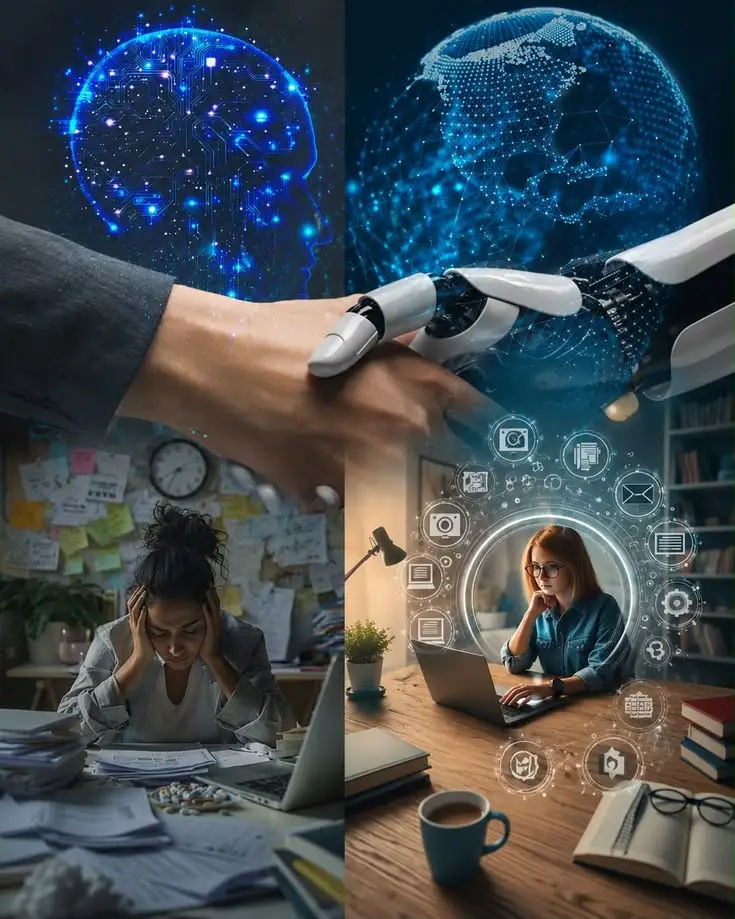
Artificial Intelligence (AI) has quietly become a part of our everyday lives. From asking questions on chatbots and using navigation apps to shopping online and watching personalised recommendations, we interact with AI more often than we realise. It saves time, makes information easier to access, and helps us complete everyday tasks. However, as we become increasingly dependent on these tools, an important question arises: Is AI making our lives easier, or are we slowly becoming too dependent on it?
1. How AI Is Making Everyday Life Easier
There is no denying that AI has made many daily activities more convenient. Students use it to understand difficult concepts, professionals use it to organise their work, and businesses use it to analyse data and improve decision-making. AI-powered translation tools help people communicate across languages, while virtual assistants make it easier to manage schedules and reminders.
For many people, AI acts like a helpful assistant that is available whenever needed. It can save valuable time, encourage learning, and simplify tasks that once required considerable effort. When used thoughtfully, it can support human creativity and productivity rather than replace them.
2. When Convenience Turns Into Dependence
The real concern begins when we stop making an effort to think independently. If students rely entirely on AI to complete assignments, they may miss opportunities to develop their own understanding. Similarly, professionals who accept every AI-generated answer without checking its accuracy may make poor decisions.
Another concern is the loss of personal expression. When every email, caption, idea, or conversation is generated by a tool, our natural ability to communicate and think creatively may gradually weaken. AI can also produce misleading information and reflect biases, making it important to question what it tells us instead of accepting every answer as a fact.
Convenience is valuable, but it should not come at the cost of curiosity, judgement, and independent thinking.
3. Finding the Right Balance
The solution is not to avoid AI completely but to learn how to use it responsibly. We should treat AI as a support system, not as a substitute for our own minds. Before accepting its suggestions, we can verify facts, consider different perspectives, and form our own opinions.
Students should use AI to learn concepts rather than simply copy answers. Professionals can use it to save time while keeping human judgement at the centre of important decisions. Most importantly, we should make space for activities that require genuine human interaction, creativity, and reflection.
Conclusion
AI is neither entirely helpful nor inherently harmful; its impact depends on how we use it. The real challenge is to enjoy its benefits without allowing it to control our habits. After all, technology should make us more capable, not less thoughtful. The smartest use of AI is knowing when to seek its help and when to trust our own minds.
Read More- https://luxuriousdreamsmagazine.com/category/exclusive/

For Advertisment & Article Conatct :+91 7321012159