
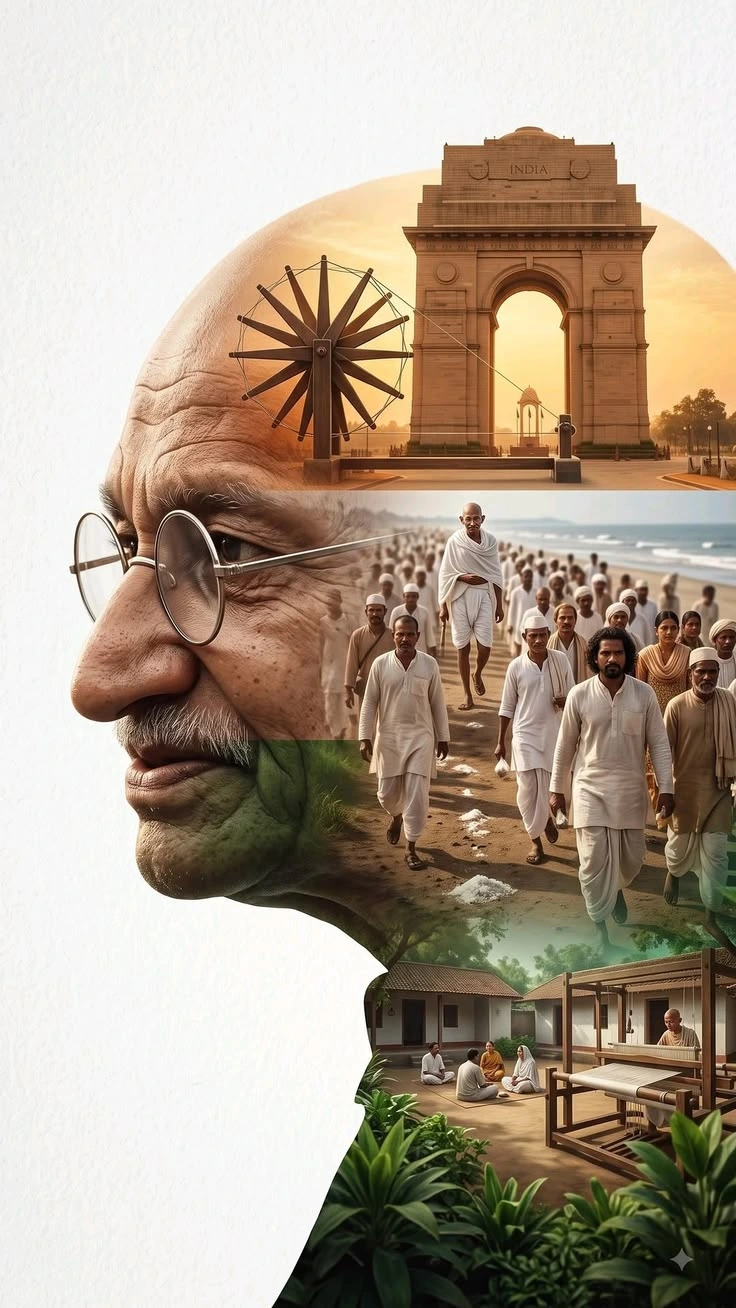
Mahatma Gandhi remains one of the most influential figures in India’s modern history. His contribution was not limited to the struggle against British rule; he also imagined an India where ordinary people could participate in nation-building, communities could become more self-reliant, and social progress would be connected with moral responsibility. Although India has changed dramatically since Gandhi’s time, several of his ideas continue to appear in public life, social initiatives, and discussions about the country’s future.
The Legacy of Truth and Non-Violence
Gandhi introduced a distinctive approach to political resistance through Satyagraha, which emphasized truth, non-violence, discipline, and peaceful public participation. His methods helped transform the freedom movement into a mass movement involving people from different sections of society. The Salt March of 1930 became one of the most recognizable examples of civil disobedience during the independence struggle.
The relevance of these ideas extends beyond the freedom movement. In a democratic society, disagreement is unavoidable, but Gandhi’s emphasis on dialogue, restraint, and peaceful action continues to offer a way of thinking about social and political change.
Village Development and Self-Reliance
Gandhi believed that India’s progress could not be measured only through large cities or industrial growth. He placed considerable importance on villages, local production, dignity of labour, and economic self-reliance. His ideas surrounding Swadeshi and Gram Swaraj encouraged people to value locally produced goods and strengthen communities from the grassroots.
Some Gandhian ideas also found expression in India’s constitutional framework. The Directive Principles include provisions concerning village panchayats, cottage industries, and social welfare, reflecting several concerns associated with Gandhian thought.
Gandhi in Everyday India
Gandhi’s influence can also be seen in campaigns and social initiatives that connect personal responsibility with public welfare. Cleanliness, community participation, rural empowerment, and social inclusion remain important themes in contemporary India. The Swachh Bharat Mission, launched in 2014, has been publicly associated with Gandhi’s emphasis on cleanliness and civic responsibility.
Yet Gandhi’s legacy is not simply about remembering a historical leader. It invites modern India to reconsider how development should be pursued, how communities can participate in change, and how individual responsibility contributes to society. His ideas may have emerged in a very different era, but their continuing presence shows why Gandhi remains an important part of India’s conversation about citizenship, development, equality, and nation-building.
Read More- https://luxuriousdreamsmagazine.com/category/agriculture/

For Advertisment & Article Conatct :+91 7321012159